Brass & Bronze Etchants
Complete guide to selecting and applying etchants for brass and bronze alloys. Covers ammonium hydroxide, nitric acid, and ferric chloride reagents with compositions, conditions, and troubleshooting for copper-zinc and copper-tin alloys.
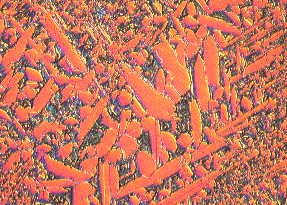
Alloy Classification & Preparation
Understanding the alloy system helps select the right etchant. Brass alloys are copper-zinc, while bronze alloys are copper-tin.
Common Brass Alloys (UNS)
Copper-zinc alloys with varying zinc content for different properties.
View alloy breakdown
- C21000 — Gilding Metal (95% Cu, 5% Zn) – Coins, jewelry
- C22000 — Commercial Bronze (90% Cu, 10% Zn) – Hardware, conduit
- C23000 — Red Brass (85% Cu, 15% Zn) – Plumbing, condenser tubes
- C26000 — Cartridge Brass (70% Cu, 30% Zn) – Ammunition, springs
- C28000 — Muntz Metal (60% Cu, 40% Zn) – Architectural trim
- C36000 — Free-Cutting Brass (61.5% Cu, 35.5% Zn, 3% Pb) – Screw machine products
- C46400 — Naval Brass (60% Cu, 39.25% Zn, 0.75% Sn) – Marine hardware
Common Bronze Alloys (UNS)
Copper-tin alloys and related compositions for specialized applications.
View alloy breakdown
- C51000 — Phosphor Bronze A (95% Cu, 5% Sn, 0.2% P) – Springs, electrical contacts
- C52400 — Phosphor Bronze D (90% Cu, 10% Sn) – Heavy springs, bridge bearings
- C54400 — Free-Cutting Phosphor Bronze – Bearings, bushings, gears
- C61400 — Aluminum Bronze D (91% Cu, 7% Al) – Pump parts, marine hardware
- C63000 — Nickel Aluminum Bronze (82% Cu, 10% Al, 5% Ni) – Valve seats, marine
- C65500 — High Silicon Bronze A (97% Cu, 3% Si) – Hydraulic pressure lines
- C86300 — Manganese Bronze (63% Cu, 25% Zn, 6% Al) – Heavy-duty gears
Preparation Tips
Brass and bronze are soft, ductile materials prone to mechanical deformation.
View key considerations
- Use low-nap polishing cloths to minimize surface relief between phases
- Avoid excessive pressure during grinding to prevent smearing of the soft copper matrix
- Vibratory polishing with colloidal silica produces excellent final results
- Alpha brass is particularly prone to twinning which is readily revealed by etching
- Multi-phase alloys require careful etchant selection to differentiate phases
- Clean thoroughly between preparation steps to prevent cross-contamination
Recommended Etchants
Selecting the right etchant is crucial for revealing brass and bronze microstructures. For a comprehensive searchable list, visit the Etchant Database.
| Etchant | Composition | Conditions | Applications |
|---|---|---|---|
| Ammonium Hydroxide (dilute) |
|
|
|
| Copper No. 1 |
|
|
|
| Copper No. 2 |
|
|
|
Troubleshooting
Common etching issues and how to resolve them.
Over-etching
Surface appears too dark or pitted. Reduce etching time significantly—brass and bronze etch quickly, especially with nitric acid. Start with 1–2 seconds and increase gradually.
Under-etching
Grain boundaries not clearly visible. Increase etching time incrementally or ensure the etchant solution is fresh and at proper concentration.
Uneven Etching
Ensure sample is completely clean and dry before etching. Residual polishing compounds can cause localized over- or under-etching.
Staining
Rinse immediately with water after etching and dry with compressed air or alcohol. Copper alloys are prone to tarnishing if left wet.
Poor Phase Contrast
For multi-phase alloys (alpha-beta brass, aluminum bronze), try ferric chloride-based etchants (Copper No. 2) for better phase differentiation.
Smearing Artifacts
If the etched surface shows directional artifacts, the sample may not have been polished adequately. Re-polish and re-etch with fresh solution.
Related Resources
Brass & Bronze Prep Guide
Step-by-step preparation procedures for brass and bronze alloys.
View guideEtchant Selector Tool
Find the right etchant for any material. Filter by alloy, application, and method.
Open toolEtchant Database
Searchable database of metallographic etchants with compositions and references.
Browse databaseMaterials Database
Look up preparation procedures, classifications, and properties for hundreds of materials.
Explore materials