Ceramic Etchants
Guide to etching engineering ceramics for metallographic analysis. Covers thermal etching, molten salt techniques, and chemical etchants for oxide, carbide, nitride, and boride ceramics.
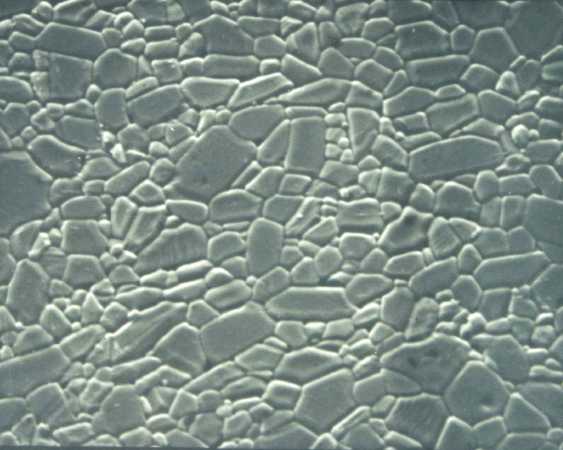
Classification & Etching Techniques
Most ceramics resist standard chemical etching. Thermal, molten salt, and plasma techniques are often required.
Ceramic Types
Classified by chemical bond type, each requiring different etching approaches.
View classification
- Oxide — Al2O3, ZrO2, mullite – Ionic bonding, high chemical stability
- Carbide — SiC, WC – Strong covalent bonding, extreme hardness
- Nitride — Si3N4, AlN – Covalent bonding, high thermal stability
- Boride — ZrB2, TiB2 – Metallic/covalent bonding, ultra-high temperature
Etching Techniques
Specialized methods needed due to the anti-corrosive properties of ceramics.
View techniques
- Thermal etching — Heating at 100–200°C below sintering temperature to reveal grain boundaries
- Molten salt — Immersion in molten salt baths in platinum crucibles
- Chemical etching — Concentrated acids or acid mixtures to attack specific phases
- Plasma etching — Ionized gas to selectively remove material at grain boundaries
Preparation Tips
Engineering ceramics are very hard and require CMP techniques to remove preparation damage.
View key considerations
- Diamond abrasives required for grinding and polishing most ceramics
- Colloidal silica final polishing recommended for optimal surface finish
- Careful sectioning with diamond wafering blades prevents fracture
- Vacuum impregnation mounting recommended for porous ceramics
- CMP component needed to remove induced microstructural damage
Recommended Etchants
Organized by ceramic type. For a comprehensive list, visit the Etchant Database.
Oxide Ceramics
| Etchant | Composition | Conditions | Applications |
|---|---|---|---|
| Thermal Etching in Air |
|
|
|
| Molten Potassium Hydrogen Fluoride |
|
|
|
| Phosphoric Acid Solution |
|
|
|
| Sulfuric Acid Solution |
|
|
|
Carbide Ceramics
| Etchant | Composition | Conditions | Applications |
|---|---|---|---|
| Molten Sodium/Potassium Bicarbonate |
|
|
|
| HCl / Hydrogen Peroxide |
|
|
|
Nitride Ceramics
| Etchant | Composition | Conditions | Applications |
|---|---|---|---|
| Thermal Etching in N2 |
|
|
|
| Molten Potassium Hydroxide |
|
|
|
| Hydrofluoric Acid |
|
|
|
Boride Ceramics
| Etchant | Composition | Conditions | Applications |
|---|---|---|---|
| Lactic / Nitric / HF Acid Mix |
|
|
|
Troubleshooting
Common ceramic etching issues and how to resolve them.
No Visible Etching
Ceramics are inherently resistant to chemical attack. Try thermal etching or molten salt techniques instead of chemical etchants.
Over-etching
Grain boundaries appear too wide or pitting occurs. Reduce etching time significantly—molten salt etching can be very aggressive once initiated.
Uneven Etching
Ensure sample surface is free of polishing residue and that thermal etching has uniform temperature distribution.
Grain Boundary Pull-out
Often caused by mechanical damage during preparation rather than etching. Improve polishing with CMP techniques.
Phase-specific Etching
If only certain phases are revealed, try alternative etchants or techniques. Different ceramic phases may need different approaches.
Thermal Etching Atmosphere
For nitride ceramics, use matching atmosphere (e.g., nitrogen for Si3N4) to prevent decomposition during thermal etching.
Related Resources
Ceramic Prep Guide
Step-by-step preparation procedures for engineered ceramics.
View guideEtchant Selector Tool
Find the right etchant for any material. Filter by alloy, application, and method.
Open toolEtchant Database
Searchable database of metallographic etchants with compositions and references.
Browse databaseMaterials Database
Look up preparation procedures, classifications, and properties for hundreds of materials.
Explore materials