Titanium Etchants
Complete guide to selecting and applying etchants for titanium and titanium alloys. The strong oxide layer on titanium requires aggressive etchants to reveal alpha and beta phases, grain boundaries, and prior-beta grain boundaries.
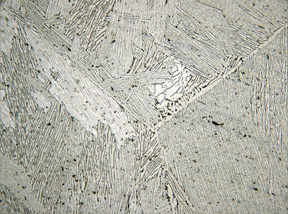
Alloy Classification & Preparation
Understanding the alloy phase composition helps select the right etchant. Titanium alloys are classified by their stabilizing elements and resulting microstructure.
Alloy Classification System
Titanium alloys are grouped by phase stability determined by alloying elements.
View alloy types
- Alpha alloys: Contain alpha stabilizers (Al, O, N, C). Good creep resistance, weldable, non-heat-treatable
- Near-alpha alloys: Predominantly alpha with small amounts of beta stabilizers. High-temperature applications
- Alpha-beta alloys: Both alpha and beta stabilizers (e.g., Ti-6Al-4V). Heat treatable, most widely used
- Near-beta alloys: High beta stabilizer content. High strength, good formability
- Beta alloys: Contain beta stabilizers (V, Mo, Nb, Fe, Cr). Heat treatable, high strength, good cold formability
- Commercially pure (CP): Grades 1–4, varying oxygen content. Corrosion resistance, biocompatibility
Common Designations
Key titanium alloy grades and their typical applications.
View grade designations
- Grade 1–4 (CP Ti): Unalloyed titanium with increasing oxygen content and strength
- Grade 5 (Ti-6Al-4V): Most common titanium alloy; aerospace, medical implants
- Grade 9 (Ti-3Al-2.5V): Moderate strength; tubing, aerospace hydraulic systems
- Grade 12 (Ti-0.3Mo-0.8Ni): Improved corrosion resistance; chemical processing
- Grade 23 (Ti-6Al-4V ELI): Extra low interstitials; medical implants, cryogenic applications
- Ti-6Al-2Sn-4Zr-2Mo: High-temperature alpha-beta alloy; jet engine components
- Ti-10V-2Fe-3Al: Near-beta alloy; high strength aerospace forgings
Preparation Tips
Titanium is reactive and prone to forming a deformed surface layer during grinding.
View key considerations
- Use water-based coolants during sectioning to prevent heat damage and oxidation
- Avoid excessive grinding pressure to minimize subsurface deformation
- Final polishing with colloidal silica or alumina is recommended to remove the disturbed layer
- Clean thoroughly between preparation steps to prevent cross-contamination
- Store prepared samples in a desiccator to prevent surface oxidation before etching
- Hydrofluoric acid requires special safety precautions: use HF-rated PPE
Recommended Etchants
While Kroll's reagent is the most commonly used general-purpose etchant for titanium, specific alloy systems and microstructural features may require specialized etchants. For PACE's full etchant catalog and the Materials Prep ELN, see Etchant Resources.
| Etchant | Composition | Conditions | Applications |
|---|---|---|---|
| Kroll's Reagent |
|
|
|
| HF-HNO3-Glycerol |
|
|
|
| Weck's Titanium Reagent |
|
|
|
Troubleshooting
Common etching issues and how to resolve them.
Over-etching
Surface appears too dark or pitted. Reduce etching time by 50% and monitor under the microscope. Titanium etches rapidly once the oxide layer is breached.
Under-etching
Grain boundaries not clearly visible. Increase etching time incrementally or ensure etchant is freshly prepared. The passive oxide layer can resist initial attack.
Uneven Etching
Ensure sample is completely dry before etching and maintain consistent immersion or swabbing motion. Alpha and beta phases etch at different rates.
Staining
Rinse immediately with water after etching and dry with compressed air to prevent water spots and residual chemical deposits.
Poor Phase Contrast
Try Weck's reagent for color contrast between alpha and beta phases, or adjust Kroll's reagent concentration for better differentiation.
Surface Artifacts
If scratch patterns appear after etching, return to polishing and ensure all deformation is removed before re-etching. Titanium is prone to subsurface damage.
Related Resources
Titanium Prep Guide
Step-by-step preparation procedures for titanium alloys, from sectioning through final polish.
View guideEtchant Catalog
Browse and filter the full PACE etchant catalog inside the Materials Prep ELN.
Open the catalogEtchant Resources
Material guides, technique reference, safety info, and the Materials Prep ELN catalog, all in one place.
Open the hubEtching Consumables
PACE's pre-mixed etchant catalog organized by material, with composition, conditions, and shop links.
Browse consumables