Introduction
Stainless steel is one of the most commonly analyzed materials in metallography. From common austenitic grades like 304 Stainless Steel to high-strength precipitation-hardening alloys, proper preparation is essential to reveal the true microstructure without introducing artifacts such as deformation, scratches, or contamination. This guide will walk you through the complete preparation process.
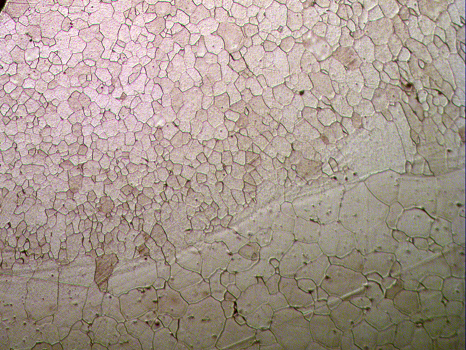
300-series austenitic stainless steel microstructure, properly prepared and etched (Carpenter's reagent, 20 s submerged). Correct preparation reveals the true grain structure and twin boundaries without introducing artifacts.
Stainless steels can be challenging due to their work-hardening characteristics and varying hardness depending on the grade. Softer austenitic grades like 304 and 316 work-harden during preparation, while harder martensitic and precipitation-hardening grades like 17-4 PH require more aggressive cutting and grinding. The key is to use appropriate abrasives and maintain consistent pressure throughout the process.
Sectioning
When sectioning stainless steel samples, use a slow cutting speed to minimize heat generation and deformation. Harder grades like 17-4 PH Stainless Steel may require even slower speeds to prevent excessive heat buildup.

MAXCUT abrasive cut-off blades for stainless steel. MAX-E (general purpose) and MAX-I (intermediate hardness) are the standard choices for austenitic, ferritic, and as-supplied martensitic grades. Reserve MAX-VHS for fully hardened martensitic and precipitation-hardening grades (HRC > 45). Thin blades (0.5-1.0 mm) minimize heat generation and deformation.
- Use MAX-E or MAX-I series MAXCUT blades for most stainless steels (304, 316, 430, annealed 410/420). Step up to MAX-VHS only for fully hardened martensitic or PH grades (e.g., heat-treated 440C, aged 17-4 PH).
- Use a thin abrasive cut-off wheel (0.5-1.0 mm thickness)
- Apply steady, moderate pressure
- Use adequate coolant to prevent overheating
- Allow the wheel to do the cutting - avoid forcing
For more information on sectioning blades, visit our Abrasive Blades collection.
Mounting
Mounting provides edge retention and easier handling. For stainless steel, compression mounting with phenolic, epoxy, or diallyl phthalate resins all work well — diallyl phthalate offers the best edge retention of the three when fine surface features near the specimen edge must be preserved. If edge retention is critical (e.g., coatings, decarb studies), consider conductive mounting materials.
Compression Mounting
- Clean the sample thoroughly to remove cutting fluid and debris
- Place sample in mounting press with appropriate resin
- Apply pressure: 3000-4000 psi for phenolic, 2000-3000 psi for epoxy
- Heat to 150-180°C and hold for 5-8 minutes
- Cool under pressure to room temperature
For more information on mounting equipment, visit our Compression Mounting Equipment page.
Grinding
Grinding removes sectioning damage and prepares the surface for polishing. Start with coarse grits and progressively move to finer grits. For stainless steel, we recommend the following sequence:

Silicon carbide (SiC) grinding papers in graded grit sizes for progressive grinding of stainless steel. US grit numbers shown with their FEPA P-grade equivalents in parentheses. Rotate sample 90° between each grit to ensure complete scratch removal.
Grinding Sequence
Start at 240 grit — coarser starting grits (e.g., 120) introduce deeper subsurface damage that smears in austenitic and annealed martensitic grades and is harder to remove later.
- 240 grit (P220): Plane the surface and remove sectioning damage (grind until plane, typically 30-60 seconds)
- 360 grit (P500): Remove 240-grit scratches (1 minute)
- 600 grit (P1200): Refine the surface (1 minute)
- 800 grit (P2400): Bridge to fine polishing (1 minute)
- 1200 grit (P4000): Final grinding step before diamond polish (1 minute)
Important: Rotate the sample 90° between each grit to ensure complete removal of previous scratches. Use water as a lubricant and maintain light, consistent pressure.
For more information on grinding supplies, visit our Silicon Carbide Grinding Papers collection.
Polishing
Polishing removes grinding scratches and prepares a mirror-like surface. For stainless steel, diamond polishing followed by oxide polishing typically yields excellent results.

Polycrystalline diamond compound provides aggressive cutting action ideal for hard materials like stainless steel.

Various polishing pads for different polishing stages. Select pad hardness based on material and polishing stage.
Diamond Polishing
Use DIAMAT polycrystalline diamond suspension with DIALUBE Purple extender as the lubricant. For stainless steel that has been ground through a full SiC progression to 1200 grit (per the grinding sequence above), the 1 µm step alone is often sufficient; the 9 µm and 3 µm steps are most useful when the grinding sequence is shortened.
- 9 μm DIAMAT diamond: 3-5 minutes on a hard pad (e.g., Texpan) — optional if grinding finished at 1200 grit
- 3 μm DIAMAT diamond: 3-5 minutes on a medium-hard pad — optional if grinding finished at 1200 grit
- 1 μm DIAMAT diamond: 2-3 minutes on an ATLANTIS polishing pad (Don's recommended pad for the final diamond step on stainless)
Final Polishing
- 0.05 μm Nanometer alumina on a TRICOTE polishing pad: 1 minute at reduced speed (~100 rpm head/base). Don's §11.5.3 specifies alumina rather than silica for stainless — alumina gives a cleaner final surface on the chromium-bearing matrix without the silica gel residue that can complicate subsequent etching.
- Rinse thoroughly with water and dry with compressed air
Use appropriate polishing lubricants and maintain consistent pressure. Over-polishing can introduce relief, especially around inclusions or second phases.
For more information on polishing supplies, visit our Diamond Abrasives and Polishing Pads collections.
Etching
Etching reveals the microstructure by selectively attacking grain boundaries and phases. The choice of etchant depends on the stainless steel grade and what features you want to reveal.

Stainless steel etched with appropriate etchant, magnification. Proper etching reveals grain boundaries and phase structure without over-etching artifacts.
Etchants by Stainless Steel Family
The right etchant depends on the family. Austenitic, ferritic, martensitic, duplex, and precipitation-hardened (PH) stainless steels each respond to different reagents.
- Austenitic (304, 316): 10% oxalic acid electrolytic at 6 V for 30-60 seconds reveals grain boundaries and twins. Glyceregia by swab is a chemical alternative when an electrolytic cell is not available.
- Ferritic (430, 446): Vilella's reagent by swab, 5-60 seconds.
- Martensitic (410, 420, 431): Vilella's reagent or 4% Picral. Reveals martensite lath and prior austenite grain boundaries.
- Duplex (2205, 2507): Beraha I tints the ferrite phase blue/brown while leaving austenite white, cleanly distinguishing the two. Klemm's I gives even stronger color contrast.
- PH stainless (15-5, 17-4): Vilella's reagent for prior austenite grain boundaries and martensitic lath structure.
- Sensitization detection (ASTM A262 Practice A): 10% oxalic acid electrolytic at 6 V for 90 seconds reveals the "ditched" structure of chromium carbide precipitation at grain boundaries. Note the longer time vs. general austenitic etching.
- Stainless welds: Lichtenberger-Bloech for austenitic welds; Beraha for ferritic welds. Fusion zone, HAZ, and base metal may each need a different etchant — document the unetched cross-section first.

Etching solutions and reagents for stainless steel. Common etchants include Vilella's Reagent, Beraha I, Glyceregia, and electrolytic oxalic acid. Etching time and method vary by family — see the family-by-family list above.
Etching Procedure
- Ensure sample is clean and dry
- Apply etchant with cotton swab or immerse sample
- Etch for 5-30 seconds (time varies by etchant and grade)
- Immediately rinse with water, then alcohol
- Dry with compressed air
Tip: Start with shorter etching times and increase if needed. Over-etching can obscure fine details. Austenitic grades like 304 typically require 10-30 seconds, while martensitic grades may need only 5-15 seconds depending on the etchant used.
For more information on etchants, visit our Etchants collection.
Troubleshooting
Common Issues and Solutions
- Scratches remaining: Insufficient grinding/polishing time or skipped grits
- Relief around inclusions: Over-polishing or too soft a pad
- Contamination: Clean between steps, use fresh abrasives
- Poor edge retention: Consider different mounting material or technique
- Over-etching: Reduce etching time or dilute etchant
Explore More Procedures
Browse our comprehensive procedure guides for material-specific preparation methods and get personalized recommendations.