PACE Technologies' abrasive belts, rolls, and powders are designed to meet the rigorous demands of metallographic sample preparation. Silicon carbide (SiC) is our most comprehensive offering, covering belts, rolls, and powders across a full grit range. Alumina and zirconia belts are also available for applications where their specific properties (less embedding on soft metals for alumina, longer life on tough metals for zirconia) justify the choice.
Use belts for automated or semi-automated machines, rolls for manual or custom-cut applications, and powders for flexible integration with cloths or composite surfaces.
Choose the Correct Abrasive
Silicon carbide is the go-to abrasive for ferrous metals and most general grinding, with the broadest product range. Alumina belts reduce abrasive embedding on soft, ductile metals (aluminum, copper, brass). Zirconia belts last longer on tough materials such as stainless steels and superalloys. For dense ceramics and cemented carbides, use diamond instead (see Diamond Grinding).
Control Grit Progression
Begin with coarse grits for initial shaping, then transition to finer grits to minimize surface damage and prepare for polishing.
Introduction
Abrasive belts, rolls, and powders from PACE Technologies offer versatile solutions for metallographic grinding across a wide range of materials. Silicon carbide (SiC) is our most comprehensive offering and is the workhorse abrasive for ferrous metals across the full hardness range, with a sharp, self-sharpening cutting action ideal for routine material removal and surface conditioning. Alumina belts are available for soft, ductile non-ferrous metals where SiC's tendency to embed becomes a problem. Zirconia belts offer extended life on tough, hard-to-grind materials such as stainless steels, nickel-based superalloys, and titanium alloys.
Rolls allow for custom sizes, belts are designed for hand and belt grinders, and powders are used with cloths, lapping plates, or composite surfaces for maximum flexibility. Note that dense engineered ceramics and cemented carbides require diamond abrasives rather than SiC, alumina, or zirconia; see our diamond grinding page.
Abrasive Grinding Guideline
Select the appropriate abrasive type, format, and grit progression based on your material and preparation objective. Grit values below are ANSI/CAMI; SiC belts on this page top out at 240 grit, so finer steps require SiC rolls, papers, or composite disks.
Material
Objective
Recommended Format & Grit (ANSI/CAMI)
Soft non-ferrous metals (Al, Cu, Brass, Zn)
Minimize abrasive embedding & deformation
Alumina belts for coarse work (best at minimizing embedding); transition to alumina papers 240→1200 grit (see Abrasive Grinding). SiC belts/rolls can substitute when alumina is not available.
Silicon Carbide abrasive belts are designed for efficient material removal and surface conditioning in metallographic sample preparation. SiC's sharp, self-sharpening grain delivers fast cutting on ferrous metals across the full hardness range and is the most economical choice for coarse stock removal. Ideal for use with belt grinders and hand-held grinding equipment.
Standard Size: 4" x 36" (fits PENTA Series and similar belt grinders)
Grit Range: 60 to 240 grit (ANSI). Belts are a coarse-grinding format; transition to SiC rolls or papers for finer steps.
Packaging: 10 belts per box for convenient bulk use
Applications: Coarse stock removal, surface preparation, deburring, and edge rounding control
Alumina (Al₂O₃) belts are the right choice when grinding soft, ductile non-ferrous metals such as aluminum, copper, brass, gold, and silver. Although alumina is slightly softer than SiC (≈2000 HV vs. ≈2500 HV), its grain is tougher and less friable, so it resists fracturing into shards that embed in soft specimen surfaces. For these materials, alumina produces cleaner finishes with fewer embedded abrasive artifacts than SiC.
When to choose alumina over SiC: Soft non-ferrous metals where SiC embedding is a concern, refractory metals (rhenium, tungsten, vanadium) prone to surface contamination.
Format: 4" x 36" belts, available in a limited set of grits (not as comprehensive as our SiC range).
Zirconia alumina belts combine zirconium oxide (ZrO₂) with aluminum oxide to produce a tough, self-sharpening abrasive. Unlike SiC, which fractures to expose new cutting edges, zirconia alumina undergoes micro-fracturing that continuously refreshes sharp cutting points while preserving the structural integrity of the grain. The result is significantly longer belt life on tough, hard-to-grind materials.
When to choose zirconia over SiC: Tough, hard-to-grind materials including stainless steels, nickel-based superalloys, and titanium alloys, especially in production environments processing high specimen volumes.
Format: 4" x 36" belts, available in a limited set of grits (not as comprehensive as our SiC range).
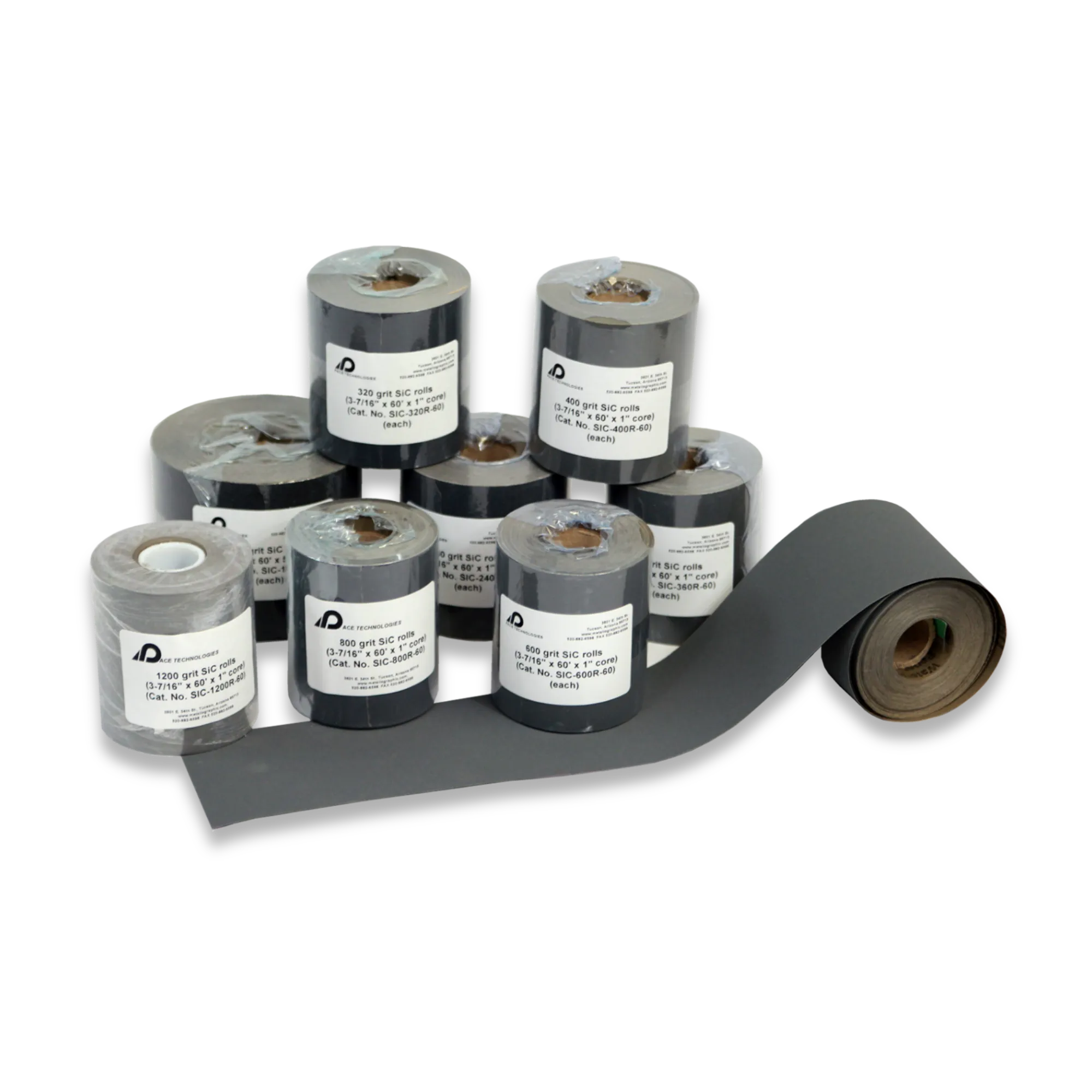
Silicon Carbide grinding rolls provide effective material removal and surface preparation for metallographic samples. These rolls offer consistent performance and durability, ensuring smooth and precise finishes on a variety of materials. Each roll is 60 feet in length with a 3-7/16-inch diameter and 1-inch core, compatible with belt/roll grinding equipment.
Roll Dimensions: 3-7/16" diameter, 60 feet length, 1" core
Grit Range: 120 to 1200 grit (ANSI/CAMI) for complete grinding progression
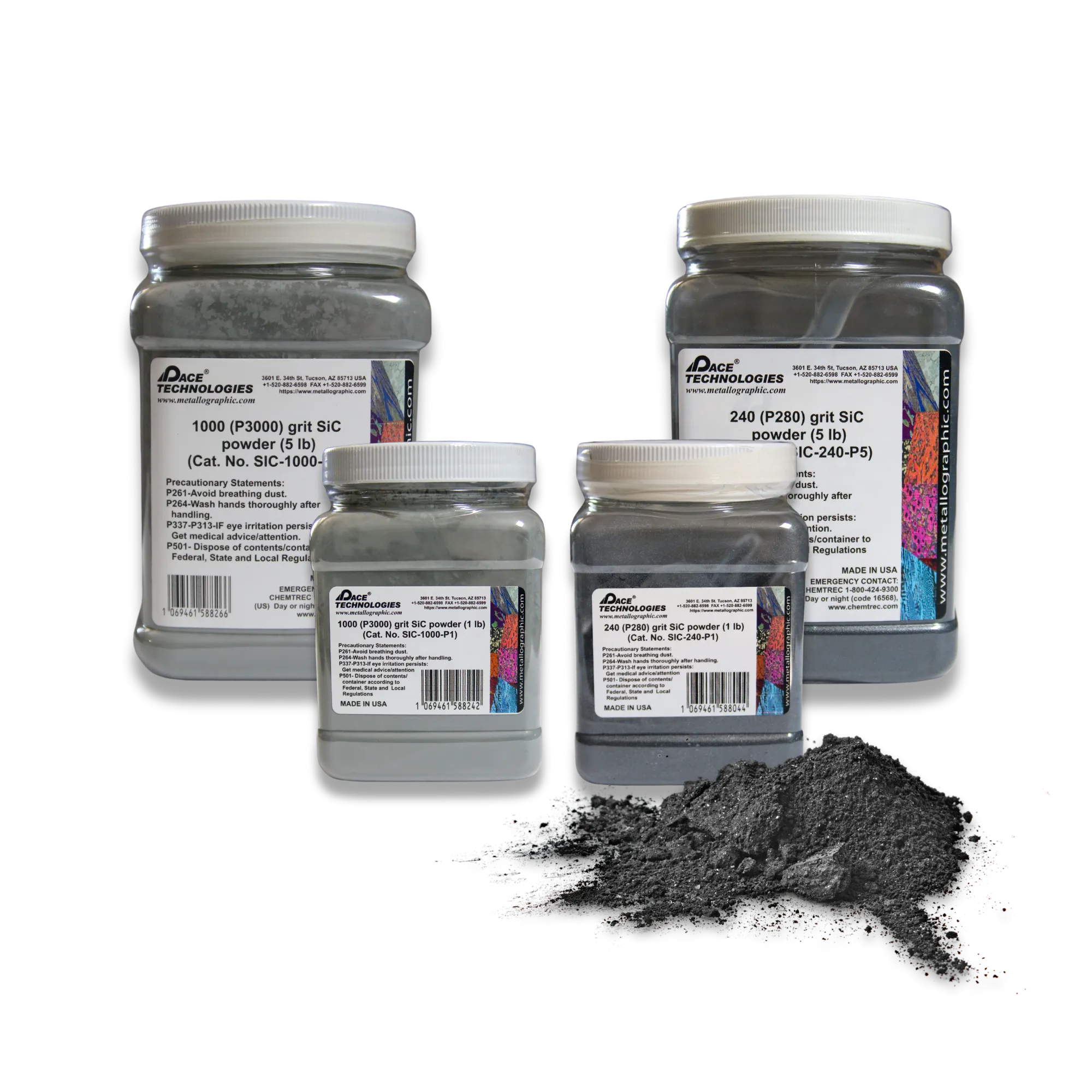
Silicon Carbide abrasive grinding powders are loose abrasives used for lapping, grinding, and polishing applications. These high-quality powders provide controlled material removal and are ideal for manual lapping operations, charging lapping plates, or creating custom grinding slurries. Available in 1 lb and 5 lb packages.
Grit Range: 120 to 1200 grit (ANSI/CAMI). See the table below for approximate P-grade equivalents.
Packaging Options: Available in 1 lb and 5 lb containers
Note: 5 lb packages also available at higher price points. Contact sales for bulk pricing. P-grade equivalents are approximate; ANSI/CAMI and FEPA P-grades use different particle-size distributions and diverge at fine grits. See our Grit Size Converter for detailed conversion.
The PENTA Series features hand grinders with silicon carbide rolls in various grits for precision material removal and surface preparation. These durable systems provide efficient grinding with water cooling for optimal metallographic sample preparation.
Expert answers about abrasive belts, rolls, and powders for metallographic preparation
What's the difference between belts, rolls, and loose powders?
Abrasive belts are pre-cut, endless loops designed for automated belt grinders and offer consistent, high-volume processing. Rolls provide continuous abrasive material that can be cut to custom sizes for manual or semi-automated applications, offering flexibility in sample preparation. Loose abrasive powders are used with lapping plates, cloths, or composite surfaces for precision grinding and polishing, particularly for achieving ultra-flat surfaces or working with delicate materials. Each format serves different workflow needs and equipment compatibility.
Can I use abrasive belts on manual grinders?
Abrasive belts are specifically designed for belt grinders with continuous-loop systems. For manual grinding equipment, abrasive rolls or discs are more suitable as they can be cut to fit your platen size. If you have a belt grinder, ensure the belt size matches your equipment specifications. Contact our technical team if you need help determining the right format for your grinder.
What grit size should I use for loose abrasive powders?
For loose abrasive powders used in lapping, start with coarser grits (180-320) for initial material removal, then progress to medium grits (400-600) for surface refinement, and finish with fine grits (800-1200) for final preparation before polishing. The exact grit progression depends on your material hardness and surface finish requirements. Silicon carbide powders are most common for general metallographic work, while alumina powders work well for softer materials.
How do I prevent abrasive contamination when using loose powders?
Always thoroughly rinse specimens and equipment between grit changes to prevent cross-contamination. Use separate cloths or lapping plates for each grit size, and clean all surfaces with water or appropriate solvents before progressing to finer grits. Store powders in sealed containers and use clean spatulas for dispensing. Consider using dedicated work areas for different grit ranges to minimize contamination risk.
Can I reuse abrasive belts or rolls?
Abrasive belts and rolls can be used until the abrasive grains become worn or loaded with material. Signs it's time to replace include reduced cutting efficiency, excessive heat generation, or visible wear on the abrasive surface. Proper lubrication and regular dressing can extend their life. Track your usage to establish replacement intervals for consistent results. Unlike loose powders which are typically single-use, belts and rolls offer extended service life with proper care.
What type of lubricant should I use with abrasive belts and rolls?
Water is the standard lubricant for silicon carbide belts and rolls, providing cooling and debris removal. Steels, aluminum, copper, and most metals are routinely wet-ground with water. For genuinely water-reactive materials such as magnesium and its alloys, sodium- or potassium-bearing specimens, and materials with water-soluble phases, use water-soluble oils or petroleum-based cutting fluids. The lubricant should maintain a consistent flow during grinding to prevent overheating and loading of the abrasive. For loose powders on lapping plates, water or light oil works well depending on the material being prepared.