
Microscopy Equipment

High-precision metallographic microscopes for material analysis, from inverted metallurgical models to stereo digital systems and advanced image analysis software. Clear imaging for metallography and material science.

Microscopy Equipment

Key Features

High-Precision Imaging

Provides detailed and accurate visual representation for material inspection and analysis with advanced optical systems.

Digital Integration

Supports camera connectivity and software compatibility for real-time imaging and data processing.

Comprehensive Measurement Tools

Enables precise measurements of structures, defects, and material properties for quality control and research.

Metallurgical Microscopes

Explore our metallurgical microscopes, engineered for precision, versatility, and clarity. Choose the IM-3000B for brightfield observation, the IM-5000 for advanced capabilities including bright-field, darkfield, polarized light, and DIC, or the premium IM-7000 with LED Köhler illumination and LM Plan S-APO objectives for exceptional resolution and digital imaging performance, designed to meet diverse lab needs.

IM-3000B Inverted Metallurgical Microscope

IM-3000B Inverted Microscope

The IM-3000B Inverted Metallurgical Microscope features brightfield and polarized light illumination, Infinite Plan Achromatic objectives (5X–100X), and a trinocular head for digital imaging, ensuring precise microstructural analysis with enhanced user comfort and control.

Illumination Brightfield & Polarized Light
Objectives 5X to 100X
Eyepiece WF 10X (22mm)
Head Trinocular
  • Illumination Technique: Brightfield and Polarized Light
  • Objectives: Infinite Plan Achromatic 5X to 100X
  • Eyepiece: Wide field WF 10X (field no. 22 mm)
IM-5000 Inverted Metallurgical Microscope

IM-5000 Inverted Microscope

The IM-5000 Inverted Metallurgical Microscope features brightfield, darkfield, polarized light, and DIC illumination for high-contrast imaging. With 5X–100X objectives and dual camera ports, it ensures precise analysis and easy documentation. Its ergonomic design enhances comfort, making it ideal for labs and research.

Illumination Brightfield, Darkfield, DIC
Objectives PL L5X to PL L100X
Eyepiece WF 10X (22mm)
Camera Ports Dual
  • Illumination Technique: Brightfield, Darkfield, Polarized Light & Differential Interference Contrast (DIC)
  • Objectives: PL L5X to PL L100X
  • Eyepiece: Wide field WF 10X (field no. 22 mm)
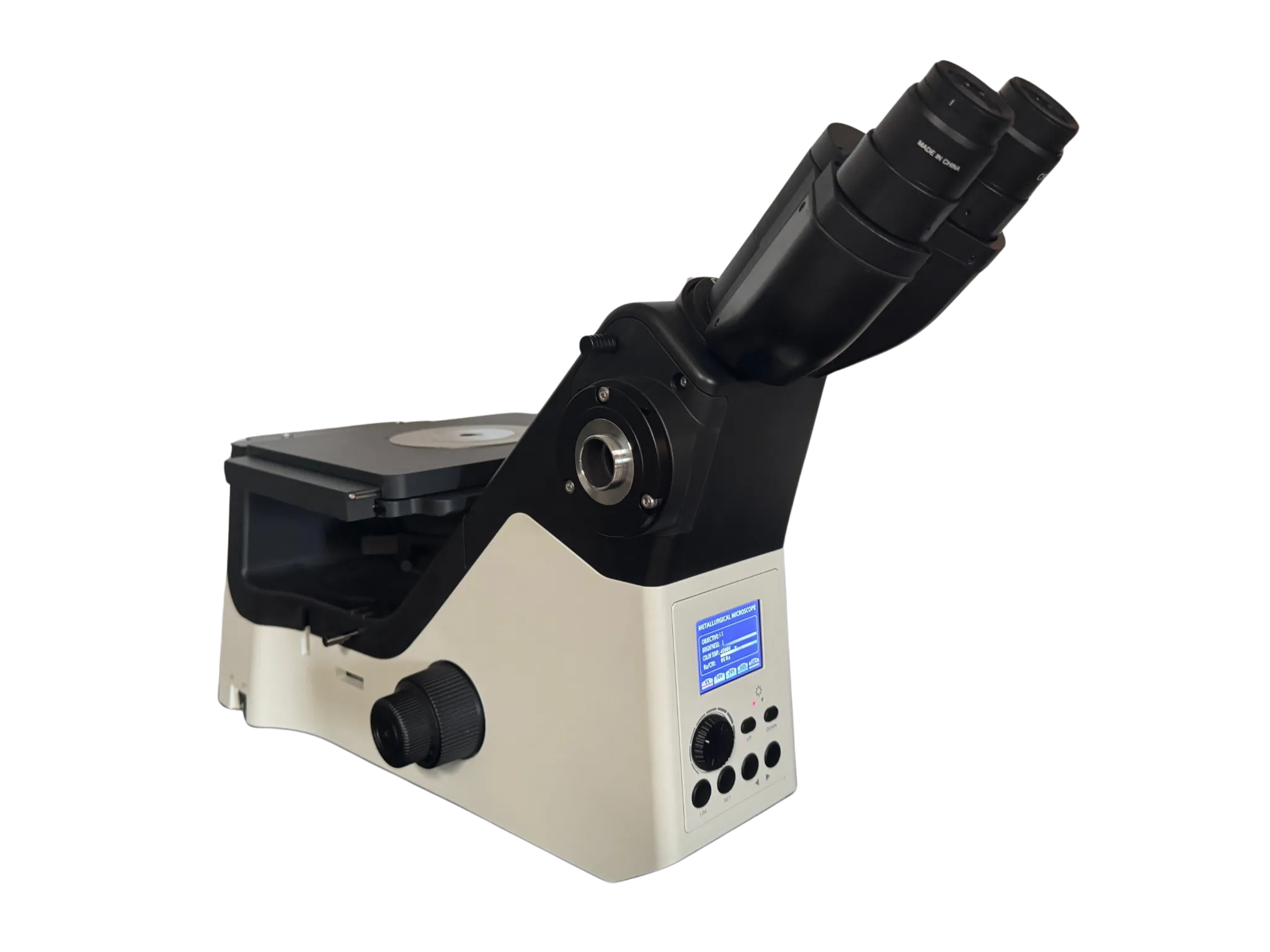
IM-7000 Premium Inverted Metallurgical Microscope

IM-7000 Premium Inverted Microscope

The IM-7000 Premium Inverted Metallurgical Microscope delivers exceptional performance with advanced illumination modes (brightfield, darkfield, polarized light, and DIC), premium LM Plan S-APO objectives, LED Köhler illumination, and ultra-wide field eyepieces. Designed for the highest resolution, color accuracy, and digital imaging performance in demanding research and quality control applications.

Illumination Brightfield, Darkfield, DIC, LED
Objectives LM Plan S-APO 5X to 100X
Eyepiece WF 10X (22mm)
Illumination Type LED Köhler
  • Illumination Technique: Brightfield, Darkfield, Polarized Light & Differential Interference Contrast (DIC)
  • Objectives: LM Plan S-APO 5X/0.15 to 100X/0.80 (long working distance, superapochromatic)
  • Eyepiece: Plan wide field WF 10X (field no. 22 mm)
  • Illumination: Köhler illumination, 10W LED (lifetime ≥ 60,000 hrs)

Stereo Microscopes

Our stereo and digital metallographic microscopes offer precision and versatility for material analysis. The VM-100 and VM-500-PLUS provide high-resolution imaging, built-in measurement tools, and user-friendly features like auto-focus and LED illumination. The ZMS0745T offers 7X–45X magnification, ideal for detailed specimen examination in research and quality control.

VM-100 Digital Stereo Microscope

VM-100 Digital Stereo Microscope

The VM-100 Digital Stereo Microscope delivers high-resolution, true-color imaging with a continuous zoom lens (0.7X - 4.5X) for precise metallographic analysis. Its built-in HD camera, adjustable LED illumination, and advanced measurement capabilities make it ideal for inspecting cracks, welds, and surface details. Designed for efficiency, it offers seamless documentation and accurate analysis for quality control and research applications.

Illumination Oblique
Zoom Range 0.7X - 4.5X
Camera 2MP (1920x1080)
Frame Rate 30fps
  • Illumination Technique: Oblique Illumination
  • Objectives: 0.7X ~ 4.5X Horizontal Zoom Lens (Zoom ratio: 6.5:1)
  • Camera Parameter: 2 million pixels (1920 x 1080), 30fps
VM-500-PLUS Digital Stereo Microscope

VM-500-PLUS Digital Stereo Microscope

The VM-500-PLUS Digital Stereo Microscope delivers high-resolution imaging with auto-focus and a 0.7X–4.5X zoom lens, making it ideal for metallographic analysis. Its built-in measurement software ensures precise analysis, while the 22-inch Full HD display and integrated VGA/USB connectivity enable seamless documentation. With adjustable LED illumination and a user-friendly interface, it offers superior clarity and efficiency for research and quality control applications.

Illumination Oblique with Auto Focus
Zoom Range 0.7X - 4.5X
Display 22" Full HD
Camera 2MP (1920x1080)
  • Illumination Technique: Oblique Illumination with Auto Focus
  • Objectives: 0.7X ~ 4.5X Horizontal Zoom Lens (Zoom ratio: 6.5:1)
  • Camera Parameter: 2 million pixels (1920 x 1080), 1080P 60fps
ZMS0745T Stereo Microscope

ZMS0745T Stereo Microscope

The ZMS0745T Stereo Metallographic Microscope offers 7X–45X magnification for high-resolution imaging and precise analysis of metallographic specimens. With true color reproduction, oblique illumination, and a trinocular head, it ensures clear, detailed observations. Ideal for quality control and research, it excels in measuring cracks, weld penetration, and surface topography with exceptional accuracy.

Illumination Oblique
Magnification 7X - 45X
Eyepiece 10X (standard)
Head Trinocular
  • Illumination Technique: Oblique Illumination
  • Total Magnification: 7-45X (with 10X eyepieces)
  • Eyepiece Options: 10x (standard), 15X and/or 20X (Optional)

Image Analysis

These metallographic software packages offer automated, high-precision analysis of microstructures, weld quality, and hardness to cut down on manual errors and speed up evaluations. They combine high-resolution imaging with industry-standard protocols for accurate, repeatable results. Their streamlined workflows and intuitive interfaces boost productivity while upholding rigorous analysis standards.

Materials Plus Software interface

Materials Plus

Materials Plus provides comprehensive image analysis that automatically quantifies microstructural features such as grain size, phase distribution, inclusions, and more, all while adhering to industry standards. This system's high-resolution imaging and integrated processing capabilities make it ideal for both materials scientists and quality control professionals.

Phases ASTM E566, E1245
Inclusions ASTM E454, E1245
Grain Size ASTM E112
Analysis Automated
  • Phases: ASTM E566, ASTM 1245
  • Inclusions: ASTM E454, ASTM E1245
  • Grain Size: ASTM E112
WELD CHECK Module Interface

WELD CHECK Module

The WELD CHECK Module offers precise measurement of weld parameters, including leg lengths, throat dimensions, and penetration, ensuring that welds meet strict industry specifications. Its intuitive interface and advanced measurement tools streamline weld inspections, improving overall product quality.

Leg Lengths Precise Measurement
Throat Height Accurate Analysis
Penetration Root Size Analysis
Interface Intuitive
  • Precise measurement of leg lengths and throat height.
  • Accurate analysis of weld penetration and root size.
Hardness Pro interface

Hardness Pro

HARDNESS PRO simplifies the hardness testing process for Vickers, Knoop, and Brinell scales by automating indentation measurements and real-time analysis. This software reduces manual errors and delivers fast, reliable hardness evaluations, making it essential for efficient materials assessment.

Scales Vickers, Knoop, Brinell
Measurement Automatic & Interactive
Image Analysis Real-time
Color Support 64-bit
  • Automatic and interactive measurement of Vickers, Knoop, and Brinell indents.
  • Real-time image analysis with high-resolution, 64-bit color support.

Enhance Your Metallographic Analysis

Microscopy reveals what proper sample preparation creates. Complete your characterization capabilities with these integrated systems.

Sample Preparation

Sample Preparation

Quality images start with quality preparation. Our grinding and polishing systems create the mirror-finish surfaces needed to reveal fine microstructural details under your microscope.

Explore Solutions →
Hardness Testing

Hardness Testing

Combine microstructural analysis with mechanical properties. Our hardness testing systems integrate with your microscopy workflow for complete materials characterization from structure to strength.

Explore Solutions →

Choosing the Right Microscopy Solution

Selecting appropriate microscopy equipment begins with understanding your imaging requirements and sample characteristics. Metallurgical microscopes serve as the foundation for microstructural analysis, offering brightfield, darkfield, and differential interference contrast (DIC) capabilities essential for revealing grain structures, phase distributions, and material defects. For routine quality control and general metallographic examination, upright metallurgical microscopes provide excellent value and versatility. However, applications involving large, heavy samples or in-situ testing may benefit from inverted configurations that allow easier specimen positioning and manipulation.

Magnification requirements and resolution needs determine optical specifications. Materials research and failure analysis typically demand higher numerical aperture objectives and advanced imaging modes to resolve fine features like precipitates, inclusions, and crack initiation sites. Production quality control environments often prioritize speed and ease of use, making stereo microscopes valuable for rapid inspection of surface features, coating integrity, and macroscopic defects. Digital microscopy and image analysis systems become essential when documentation, measurement, and statistical analysis are required, particularly critical in aerospace, biomedical device manufacturing, and materials certification where traceable, quantitative data supports regulatory compliance.

Integration capabilities also influence equipment selection. Modern metallographic workflows increasingly rely on digital capture, automated measurement, and data management. Image analysis software enables grain size determination per ASTM E112, inclusion rating, coating thickness measurement, and porosity quantification. For laboratories requiring high-throughput analysis or advanced imaging techniques like 3D surface profiling, investing in comprehensive imaging systems with automation capabilities delivers significant efficiency gains and improved measurement reliability. Contact our microscopy specialists to discuss your specific application requirements and explore demonstration options.

Frequently Asked Questions

Common questions about metallographic microscopy and imaging

What magnification do I need for metallographic analysis?

Required magnification depends on the features you need to resolve. General microstructure examination typically uses 50-500X magnification. Grain size measurement per ASTM E112 often requires 100-200X. Inclusion analysis and coating evaluation may need 200-1000X. For fine precipitates, carbides, or crack initiation studies, magnifications up to 1000-1500X are common. Most metallurgical microscopes offer magnification ranges from 50X to 1000X or higher. Consider the smallest feature you need to resolve. Numerical Aperture (NA) of objectives matters more than magnification alone for resolving fine details. Our microscopy specialists can help match optical specifications to your analysis requirements.

What is the difference between brightfield, darkfield, and DIC imaging?

Brightfield illumination provides standard reflected light imaging where light reflects directly from the sample surface. Ideal for observing phases, grain boundaries, and general microstructure after etching. Darkfield illumination uses oblique lighting to highlight surface relief, scratches, and cracks by scattering light. Excellent for detecting defects and revealing features without etching. Differential Interference Contrast (DIC) enhances topographical features and phase contrast, providing 3D-like images of surface relief. Particularly valuable for viewing subtle features in un-etched samples or studying surface coatings. Most metallurgical microscopes offer multiple illumination modes for versatile sample characterization.

Do I need an upright or inverted metallurgical microscope?

Upright microscopes work best for smaller, easily positioned samples and provide ergonomic viewing for extended observation sessions. Inverted microscopes excel with large, heavy samples like engine blocks or structural components because samples rest face-down on the stage by gravity. No special clamping required. Inverted configurations also facilitate in-situ testing where samples cannot be moved or must remain in specific orientations. For routine laboratory work with standard metallographic mounts, upright microscopes are typically more practical and economical. Consider your typical sample sizes, weights, and handling requirements when selecting configuration.

What is image analysis software and do I need it?

Image analysis software captures digital images and performs quantitative measurements including grain size determination, phase fraction analysis, inclusion ratings, coating thickness measurements, porosity quantification, and particle size distribution. It's essential for quality control applications requiring documented measurements per standards like ASTM E112 (grain size), ASTM E1245 (inclusion content), or ASTM E2109 (inclusion rating). Image analysis eliminates subjective visual comparisons, provides statistical data, enables trend analysis, and creates audit trails for regulatory compliance. For aerospace, biomedical, and certified testing, image analysis is increasingly mandatory rather than optional.

How do I maintain my metallurgical microscope?

Regular maintenance includes keeping optical surfaces clean using proper lens tissue and solutions (never touching lenses with fingers), protecting the microscope with a dust cover when not in use, and ensuring the work area is clean to prevent contamination. Check and clean illumination systems periodically, replace bulbs before failure disrupts work, and verify optical alignment annually. Store objectives properly and handle carefully to avoid damage. Avoid exposure to corrosive fumes from etching or chemicals. Professional service every 1-2 years ensures optimal performance. We provide detailed maintenance protocols and offer service contracts including preventive maintenance, optical alignment, and calibration verification.

Do you provide application support and training for microscopy?

Yes, comprehensive training and applications support are included with all microscopy systems. Initial installation includes operator training on microscope operation, illumination techniques, digital imaging, and basic image analysis. We offer advanced training on specific analysis methods, standards compliance (ASTM, ISO), troubleshooting, and method development. Our applications team assists with technique optimization for your specific materials and analysis requirements. Technical support continues throughout ownership, including software updates, analysis method development, and performance optimization. Sample evaluation services help establish baseline procedures before equipment purchase. Contact us to discuss your specific imaging and analysis needs.