Very Hard Brittle Materials & Cermets
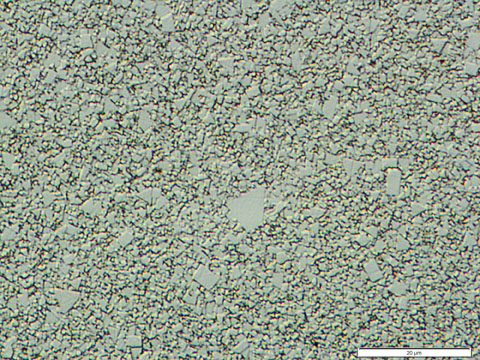
Class 11 groups materials whose defining characteristic is extreme brittleness: they all fail by fracture rather than deformation during preparation, regardless of their actual hardness. The class spans technical glasses (500 HV, amorphous, zero fracture toughness) through cemented carbides and cermets (WC-Co at 1100-1800 HV, TiCN-Ni at 1400-1800 HV) to superabrasives (PCD at 10000+ HV, cBN at 4500 HV). Cemented carbides present the most common challenge: the hard WC grains (1800-2400 HV) sit in a soft cobalt binder (~200 HV), creating severe hardness mismatch that causes binder smearing and carbide pull-out. Superabrasives are harder than almost any polishing abrasive, making material removal extremely slow. Technical glasses have no grain boundaries to arrest crack propagation, so any fracture can run across the entire specimen. Diamond abrasives are mandatory throughout, loads must be minimized, and each material subfamily requires specific preparation adjustments.
Overview
Despite spanning an enormous hardness range, all Class 11 materials share brittle fracture behavior. Preparation force must be minimized throughout, diamond abrasives are mandatory, and each material subfamily presents distinct challenges from binder smearing in cemented carbides to crack propagation in glasses.
Preparation Challenges
Seven properties drive the prep procedure. Tap a card for full detail.
Carbide-Binder Hardness Mismatch Hard WC grains (1800-3200 HV) in soft Co/Ni binder (~200 HV) cause relief and edge chipping.
Cemented carbides (WC-Co, TiCN-Ni) combine very hard carbide grains (1800-3200 HV) with a soft metallic binder (cobalt ~200 HV, nickel ~250 HV). The binder grinds and polishes far faster than the carbide, creating relief that leaves carbide grains protruding above the surface. Unsupported carbide edges then chip or pull out during subsequent polishing steps, compounding the damage.
Binder Phase Smearing Soft Co/Ni binder smears across carbide faces, masking the true interface.
The soft cobalt or nickel binder in cemented carbides smears over carbide grain faces during grinding and polishing. This is the single most common preparation artifact in hardmetals: the smeared binder masks the true carbide-binder interface, making grain size measurement and binder mean free path analysis unreliable. Diamond on rigid napless cloths with very light pressure (10-15 N) minimizes smearing.
Carbide & Grain Pull-Out Napped cloths catch grain edges and fracture carbides free, mimicking sintering porosity.
Excessive grinding force fractures carbide grains free from the binder matrix, leaving voids indistinguishable from real sintering porosity. Once a carbide grain pulls out, the void destabilizes neighboring grains. For pure carbides (WC, TiC) without a binder, entire grains fracture along boundaries. Napped polishing cloths catch grain edges and are the primary cause; napless cloths are mandatory.
Superabrasive Preparation Paradox PCD and cBN are harder than almost any abrasive, so removal is extremely slow.
Polycrystalline diamond (PCD) and cubic boron nitride (cBN) are harder than almost any abrasive used to prepare them. PCD can only be effectively polished by diamond itself, making material removal rates extremely low. Standard metallographic polishing barely touches these materials. Extended vibratory polishing with fine diamond (1-3 µm) for several hours, or specialized lapping on cast iron plates with diamond paste, is typically required.
Glass Fracture Sensitivity Amorphous glasses have no boundaries to arrest cracks; a single fracture can split the specimen.
Technical glasses are amorphous with no grain boundaries to arrest crack propagation. Once a crack initiates during sectioning or grinding, it can run across the entire specimen instantaneously. Extremely slow cutting speeds, gentle clamping with rubber jaws, and starting with finer abrasives (40 µm diamond instead of 75 µm) reduce the risk of catastrophic fracture.
Subsurface Fracture Damage Hidden microcracks at carbide-binder interfaces surface as false features under Murakami's.
All Class 11 materials develop subsurface microcracks during grinding. In cemented carbides, these cracks follow the carbide-binder interface and are invisible until Murakami's etch reveals them as apparent microstructural features. Each successive preparation step must remove the damage layer from the previous step, typically requiring removal of 2-3x the previous abrasive size in depth.
Cobalt Oxidation Sensitivity Co binder stains dark under water-based lubricants; switch to oil or alcohol carriers.
The cobalt binder in WC-Co cemented carbides oxidizes rapidly when exposed to water-based lubricants, producing dark staining identical to the artifact seen in Class 7 WC-Co thermal spray coatings. Oil-based or alcohol-based diamond suspensions must be used throughout all grinding and polishing steps for cobalt-containing materials.
Class 11 Materials
Eight materials across four subfamilies. Each subfamily needs distinct preparation adjustments.
Cemented Carbides & Cermets
- WC-Co Cemented Carbide (Hardmetal)
- TiCN-Ni Cermet
Pure Carbides
- Titanium Carbide (TiC)
- Tungsten Carbide (WC)
Superabrasives
- Polycrystalline Diamond (PCD)
- Cubic Boron Nitride (cBN)
Technical Glasses
- Borosilicate Glass
- Soda-Lime Glass
Recommended Procedure
Five-stage workflow. Diamond throughout, oil-based suspensions for cobalt-bearing alloys, napless cloths mandatory.
-
1
Sectioning
Diamond wafering blades, very slow feed, rubber-jaw clamping; electroplated diamond for PCD/cBN.
More detail
Diamond wafering blades with very slow feed rates and generous coolant. Clamp with rubber or soft jaws to distribute force and avoid point loading, which initiates fracture in brittle materials. For cemented carbides, standard diamond wafering blades work well. For PCD and cBN, use electroplated diamond blades on a precision saw; abrasive blades are completely ineffective against superabrasives. For glasses, the primary risk is crack propagation from the cut face; use the slowest feed rate available and handle with extreme care.
-
2
Mounting
Castable epoxy with vacuum impregnation. Never compression mount; thermal shock cracks glasses and carbide interfaces.
More detail
Castable epoxy with vacuum impregnation is required. The epoxy fills microcracks from sectioning and stabilizes carbide grain boundaries during grinding. Never use compression mounting: thermal shock from the heating cycle (150-180°C) cracks glasses and can damage carbide-binder interfaces. For WC-Co cemented carbides, vacuum impregnation fills the porous binder network and supports carbide grains at specimen edges. Add alumina filler to the epoxy for edge retention when surface hardness or coating analysis is needed.
-
3
Grinding
Diamond discs: 75 → 40 → 15 µm. Oil-based lubricant for Co/Ni alloys; glasses start at 40 µm.
More detail
Diamond grinding discs exclusively: 75, 40, and 15 µm. Apply very light pressure (10-15 N) because these materials fracture rather than deform under excessive load. For cemented carbides (WC-Co, TiCN-Ni), use oil-based lubricants to prevent cobalt or nickel oxidation staining. For glasses, start at 40 µm (not 75 µm) to minimize initial fracture damage. Rigid, flat grinding surfaces are critical. Each step must fully remove the subsurface damage layer from the previous step before proceeding.
-
4
Polishing
9 → 3 → 1 µm diamond on napless cloths, then 0.05 µm colloidal silica. Extended vibratory for PCD/cBN; CeO₂ slurry for glass optical finish.
More detail
Polish with 9 µm diamond on a napless cloth, then 3 µm diamond on a napless cloth, then 1 µm diamond on a napless cloth. Final polish with 0.05 µm colloidal silica for 5-15 minutes. Napless cloths are mandatory for cemented carbides to prevent binder smearing. For PCD and cBN, standard polishing has minimal effect; extended vibratory polishing with 1-3 µm diamond for 2-4 hours, or specialized lapping on cast iron plates with diamond paste, is typically required. For glasses, the traditional optical-finish abrasive is a cerium oxide (CeO₂) slurry on a hard pad; see PACE CeO₂ polishing slurry. Colloidal silica CMP is an effective alternative because its chemical component attacks the amorphous surface, but cerium oxide remains the standard for true optical-quality finishes.
-
5
Etching
Murakami's swab for WC-Co carbide reveal; aqua regia attacks the binder. PCD & cBN resist chemical etching; glasses evaluate as-polished.
More detail
Cemented carbides: Murakami's reagent at room temperature selectively darkens the WC carbide phase while leaving the Co binder bright; swab 5-10 seconds. For eta phase (W₃Co₃C) detection, use Murakami's at elevated temperature (60-80°C). Dilute aqua regia selectively attacks the cobalt binder, revealing carbide grain shape and size for image analysis. PCD grain boundaries can sometimes be revealed by plasma etching in a reactive ion etcher. Technical glasses are evaluated entirely as-polished for inclusions, bubbles, and internal stress (under polarized light with crossed polars).
Common etchants by material
Class 11 materials largely defy chemical etching. Polished-surface and SEM-based evaluation is the norm; etching is reserved for cermets where binder/carbide contrast is needed.
- WC-Co cemented carbide
- Murakami's (carbide reveal); FeCl₃ in HCl + H₂O (Co binder); electrolytic NaOH
- TiCN-Ni cermet
- Murakami's; modified Murakami's for Ni-binder contrast
- Polycrystalline diamond (PCD)
- No effective chemical etch; SEM and polarized light only
- Cubic boron nitride (cBN)
- No effective chemical etch; molten salts attack only at extreme conditions
- Technical glasses
- Dilute HF; extreme caution; most evaluation is as-polished
Ceramic etchant guide (WC-Co) → Learn about etchants → Shop etchants →
Quality Checks
- No carbide pull-out voids or binder smearing over carbide grain faces
- Surface flat with minimal relief between carbide grains and binder phase
- No subsurface microcracking visible after Murakami's etch (cemented carbides)
- No edge chipping at specimen perimeter or mounting interface
- Carbide grain boundaries clearly resolved after etching; glass surfaces free of fracture artifacts