
Class 6 covers high-performance non-ferrous alloys that share a common preparation profile: rapid work hardening, tenacious oxide formation, and multiple phases that must be preserved without relief. The class spans commercially pure titanium through precipitation-hardened nickel superalloys (Inconel 718, Waspaloy) and carbide-bearing cobalt-chromium alloys (Stellite 6, CoCrMo medical grades). Titanium and zirconium alloys add the complication of extremely rapid surface oxidation and low thermal conductivity that concentrates heat during sectioning. Nickel superalloys require careful polishing to preserve fine gamma-prime precipitates, while cobalt alloys demand controlled grinding to retain primary carbides. All of these materials need specialized etchants tailored to their specific phase chemistry.
Preparation Characteristics & Challenges
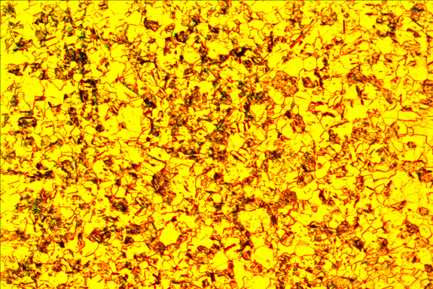
Hastelloy, Adler's etch, 200X (DIC)
Class 6 alloys share several preparation characteristics that distinguish them from other classes. Work hardening, oxide formation, and multi-phase microstructures create challenges at every step from sectioning through etching.
Rapid Work Hardening
All Class 6 alloys work-harden quickly during grinding and polishing. Excessive pressure or prolonged grinding creates a deformed layer that masks the true microstructure. Light loads (20-25 N), fresh abrasives, and contra-rotation are essential to minimize subsurface damage.
Surface Oxide Formation
Titanium and zirconium form oxide layers within seconds of exposure to air or water. These thin, tenacious oxides can obscure grain boundaries and phase features. Minimize time between final polishing and examination, and avoid prolonged rinsing.
Gamma-Prime & Delta Phase Preservation
Nickel superalloys (Inconel 718, Waspaloy, Nimonic 80A) contain fine gamma-prime (Ni₃Al/Ni₃Ti) or delta phase precipitates critical to their properties. Aggressive polishing on napped cloths can pull these precipitates from the matrix, creating pits that look like porosity.
Alpha-Beta Phase Relief
Titanium alloys have alpha (HCP) and beta (BCC) phases with different hardness that polish at different rates, creating relief. Napless cloths and short polishing times minimize height differences between phases. Vibratory polishing with colloidal silica produces the flattest surfaces.
Carbide Retention
Cobalt-chromium alloys and some Hastelloys contain primary carbides (M₆C, M₂₃C₆, MC) that can pull out during polishing if the cloth nap is too aggressive or if loads are too high. Diamond on napless cloths at moderate pressure retains carbides best.
Low Thermal Conductivity
Titanium's thermal conductivity is roughly one-quarter that of steel, concentrating heat at the cutting interface during sectioning. This can cause localized phase transformation, oxidation discoloration, or heat-affected zones. Slow feed rates and generous coolant flow are required.
Alloy-Specific Etching
Each alloy family requires a different etchant: Kroll's for titanium, Marble's or Kalling's No. 2 for nickel alloys, electrolytic oxalic acid for gamma-prime in superalloys, and Murakami's for carbide distribution in cobalt alloys. Universal etchants do not exist for this class.
Class 6 Materials
The following materials are classified as Class 6 (Tough, Hard Non-Ferrous Metals). Click on any material to view its detailed preparation procedures.
Commercially Pure Titanium
- Commercially Pure Titanium Grade 1
- Commercially Pure Titanium (Grade 2)
- Commercially Pure Titanium Grade 3
- Commercially Pure Titanium Grade 4
Titanium Alloys
- Beta C Titanium
- Ti-3Al-2.5V
- Ti-5Al-2.5Sn
- Ti-6Al-2Sn-4Zr-2Mo (Grade 5)
- Ti-6Al-4V (Grade 5)
- Ti-15V-3Cr-3Al-3Sn
Inconel (Ni-Cr-Mo Alloys)
Hastelloy (Ni-Mo/Cr Alloys)
Other Nickel Alloys
Cobalt-Chromium Alloys
Zirconium Alloys
Additive Manufactured
Preparation Guide
Recommended Preparation Steps
Sectioning
Use aluminum oxide (non-ferrous) abrasive blades with generous coolant flow. Titanium has very low thermal conductivity, so slow feed rates are critical to avoid heat-affected zones and oxidation discoloration at the cut face. Keep titanium fines wet at all times (dry titanium swarf is a fire hazard). Precision wafering is preferred for additive manufactured samples to preserve the as-built columnar grain structure.
Mounting
Compression mounting (150-180°C) is acceptable for most wrought titanium and nickel alloys, as these temperatures do not alter their microstructure. Use castable (cold) mounting for additive manufactured parts where porosity must be preserved, for medical implant surfaces, or when edge retention is critical (e.g., oxide scale examination on titanium). Vacuum impregnation with low-viscosity epoxy is recommended for porous AM parts.
Grinding
Start at 240 grit SiC and progress through 320, 400, and 600 grit. Use light pressure (20-25 N) and contra-rotation to minimize work hardening and subsurface deformation. Replace SiC papers frequently because these alloys load the abrasive quickly. Diamond grinding discs (75 and 40 µm) are an effective alternative for nickel superalloys and cobalt-chromium alloys, providing more consistent material removal with less deformation.
Polishing
Polish with 9 µm polycrystalline diamond on a napless cloth, then 3 µm diamond on a napless cloth. Final polish with 0.05 µm colloidal silica on a short-nap cloth for 1-2 minutes. Use napless cloths throughout the diamond steps to minimize relief between alpha/beta phases (titanium) and to retain carbides (cobalt alloys). Vibratory polishing with colloidal silica for 30-60 minutes produces the flattest surfaces and best phase contrast for superalloys.
Etching
Kroll's reagent (1-3 mL HF, 2-6 mL HNO₃, water to 100 mL) for all titanium and zirconium alloys; swab 5-15 seconds. Marble's reagent (10 g CuSO₄, 50 mL HCl, 50 mL water) or Kalling's No. 2 for solid-solution nickel alloys; swab 10-30 seconds. Electrolytic etching with 10% oxalic acid at 3-6V DC reveals gamma-prime distribution in precipitation-hardened superalloys (Inconel 718, Waspaloy). Murakami's reagent (10 g KOH, 10 g K₃Fe(CN)₆, 100 mL water) at room temperature highlights carbide distribution in cobalt-chromium alloys. Swab etching is preferred over immersion for better control across all alloy families.
Quality Verification
No work hardening artifacts (scratches or deformation twins) visible at 500X
Phase boundaries clearly defined with minimal relief between alpha/beta (Ti) or gamma/gamma-prime (Ni)
Carbides and precipitates retained in place with no pull-out pits
No oxide discoloration on titanium or zirconium surfaces
Grain boundaries uniformly revealed without preferential attack or over-etching